
Criminal Cases in the Lafourche Parish Courts
The 17th Judicial District Court exercises Louisiana district-court criminal jurisdiction in Lafourche Parish. Its five divisions operate from two Thibodaux courthouses. Divisions A, B, and E sit in the Old Courthouse at 201 Green Street; Divisions C and D sit in the Courthouse Annex at 303 West Third Street. The Clerk’s criminal docket line is 985-447-5512.
A district-court file begins only after a prosecution enters the court system. An officer’s arrest report and an LPCC booking can therefore exist before or without a filed 17th JDC case. For a charge, plea, minute entry, judgment, or sentence, use the Clerk. For an incident report, use the agency that created it; for present custody, use the sheriff’s inmate channel.
Five Divisions, Two Thibodaux Courthouses
Knowing the division and docket number prevents a trip to the wrong building. Division A, Judge Rebecca Robichaux, and Division B, Judge Jennifer Richard, are on the Old Courthouse first floor. Division E, Judge Shaun-Philip J. George, is on its second floor. Division C, Judge Marla M. Abel, is on the Annex third floor, while Division D, Judge Christopher J. Boudreaux, is on its second floor.
The Seventeenth Judicial District Court’s official site provides the institutional starting point for Lafourche Parish district-court information.
This court-level source establishes the correct jurisdiction before a reader moves to the Clerk’s docket and document channels.
Counter route: The Annex at 303 West Third Street is the key Clerk location for criminal files, official searches, copies, certifications, filing, and expungement forms. Confirm the needed service at 985-447-5512 before traveling from lower Lafourche.
The court’s official division contact page identifies the judges, courthouse floors, and telephone routes for the five divisions.
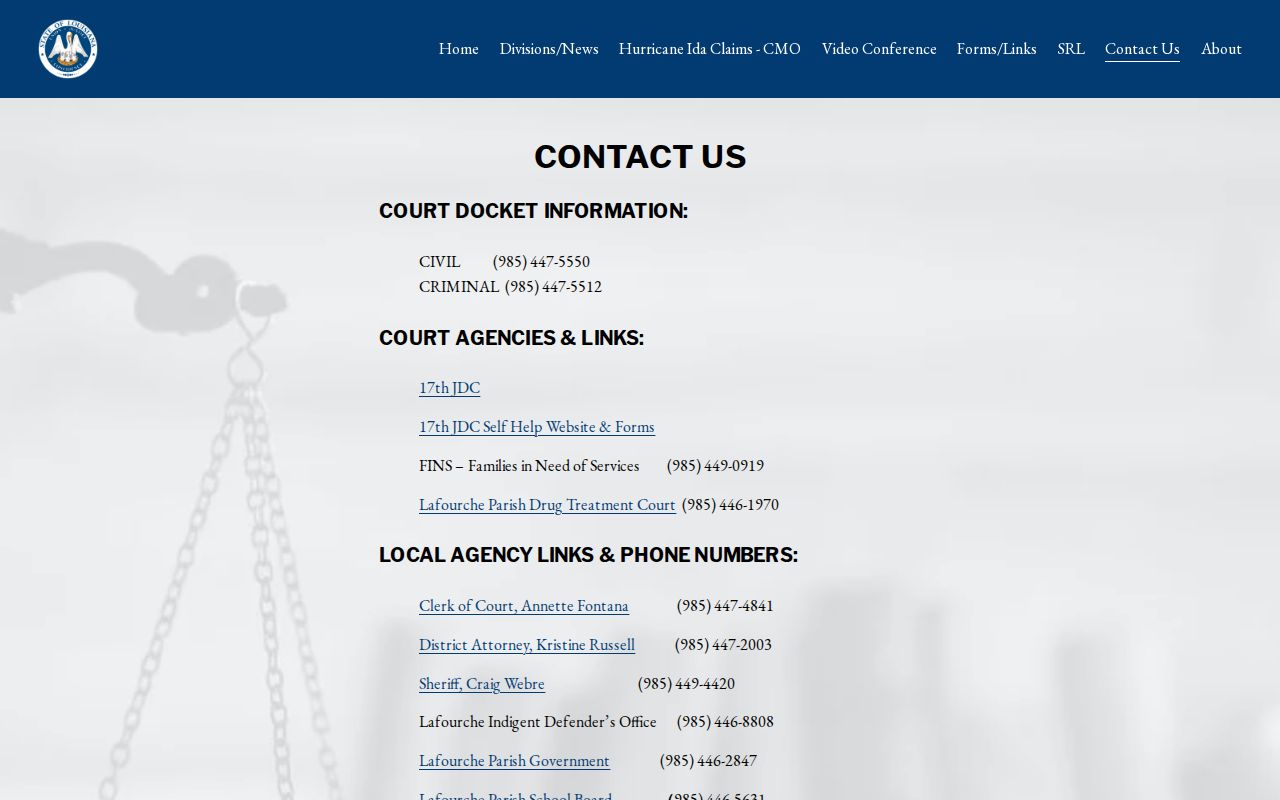
Use the assigned division only after confirming it from the docket; the division contact is not a replacement for a Clerk record search or certified copy.
How to Search Case Records
The parish offers several access channels. Clerk Connect criminal inquiry is the paid online index. It requires registration, a subscription, JavaScript, and a current browser. The separate free Court Date Finder is useful for upcoming settings but does not prove a disposition. The criminal customer-service desk can conduct an official search, locate older material, and explain whether an image must be retrieved or reviewed at the counter.
The Clerk’s criminal search and Court Date Finder routing page shows where these two access tools diverge.
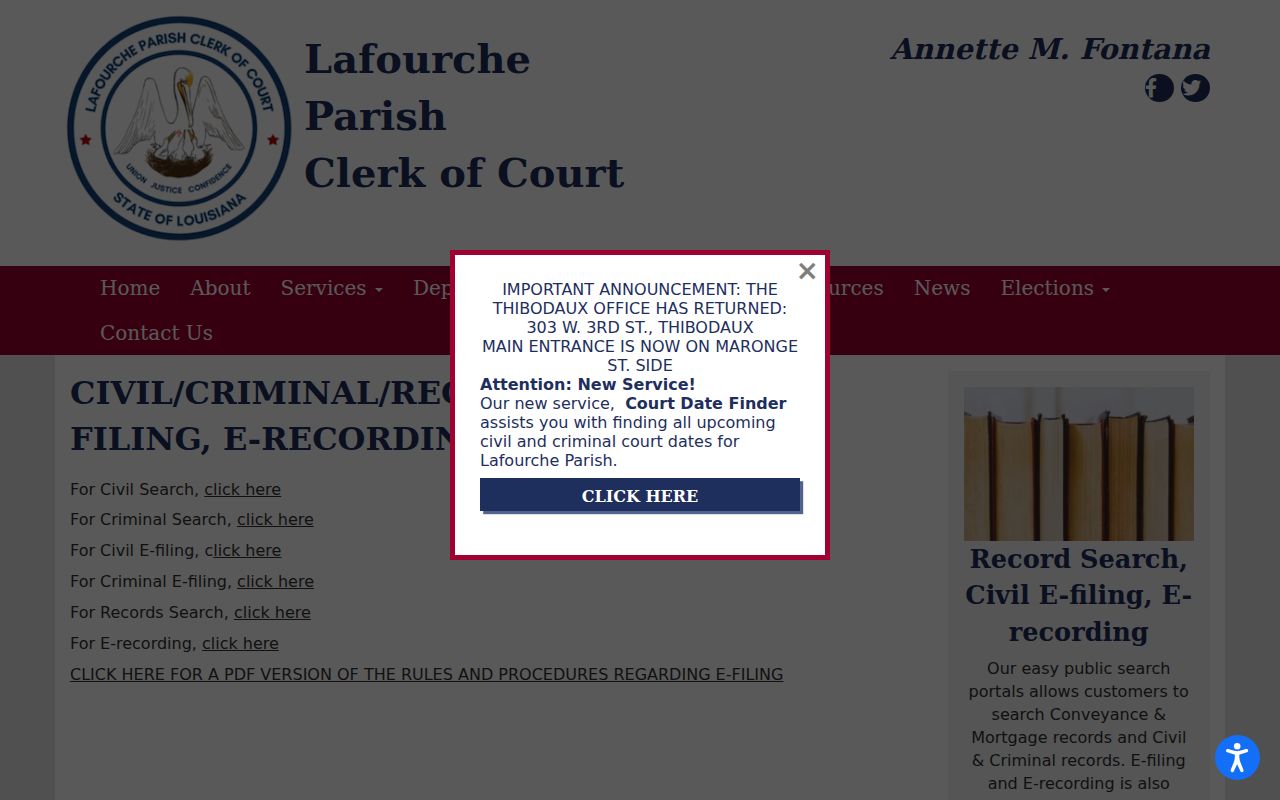
That distinction prevents an upcoming calendar result from being mistaken for a final disposition or complete case history.
- Start with the person’s full name, approximate filing year, and docket number if known.
- Use Clerk Connect for the released index, minutes, and available images within its date coverage.
- Use Court Date Finder only to check an upcoming civil or criminal setting.
- Call or visit the criminal desk for older cases, absent images, certified copies, or access questions.
| Search Field | What to Enter | Tip |
|---|---|---|
| Party name | Full legal name and known spelling variants | Confirm identity against docket details |
| Docket number | Official case number | Best key for copies and certification |
| Filing range | Approximate prosecution year | Portal index begins July 1, 1982 |
| Division | A through E, when known | Helps identify the judge and building |
Inside the Paid Clerk Connect Portal
Clerk Connect contains only records that have been recorded, indexed, verified, and released. Its criminal index reaches from July 1, 1982; minutes from January 1, 2001; and document images from March 2018. Access costs $20 for one day, $50 for 30 days, or $550 per year. Maintenance, power loss, disasters, or system failure may interrupt availability.
The Clerk’s broader records-search page explains the scope of its online searches and subscription access.
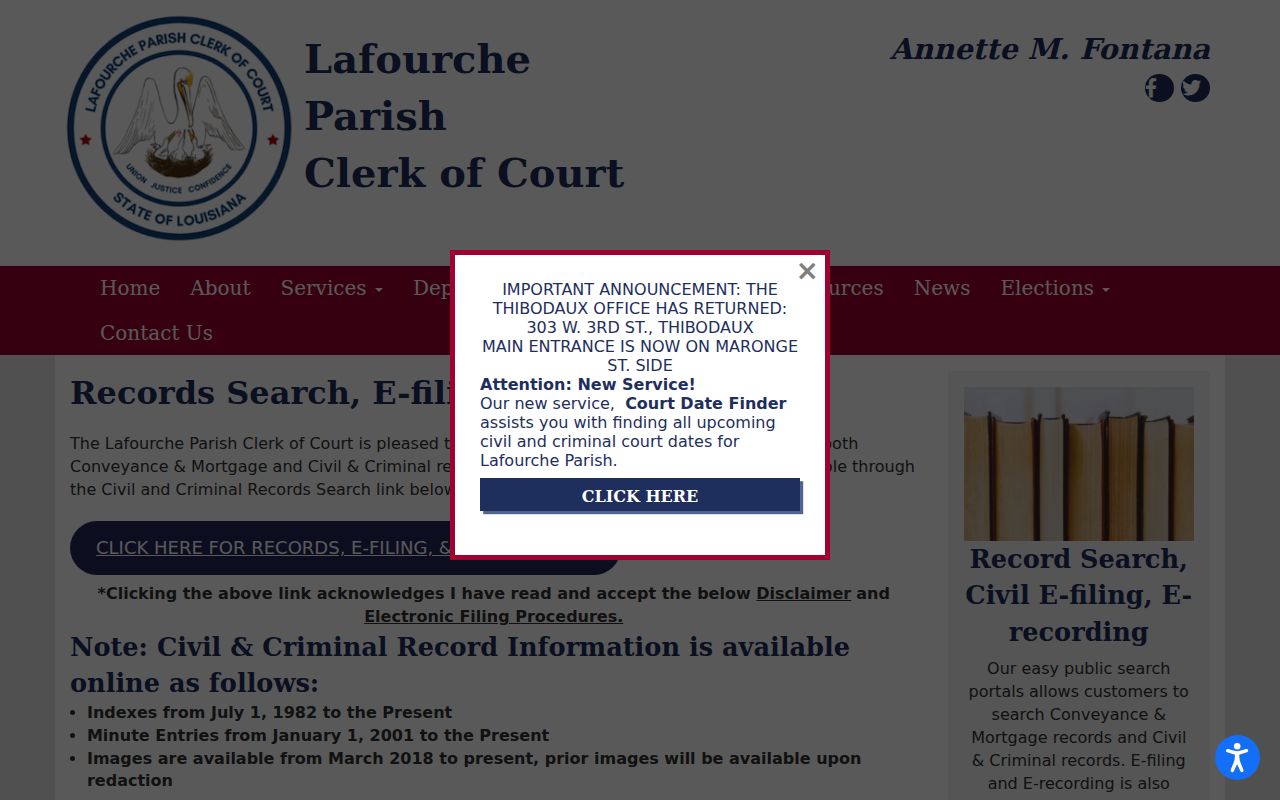
This overview is useful for selecting the service before paying, while the criminal inquiry remains the record-type-specific destination.
The live Lafourche criminal inquiry portal is the direct online entrance for the parish criminal index.
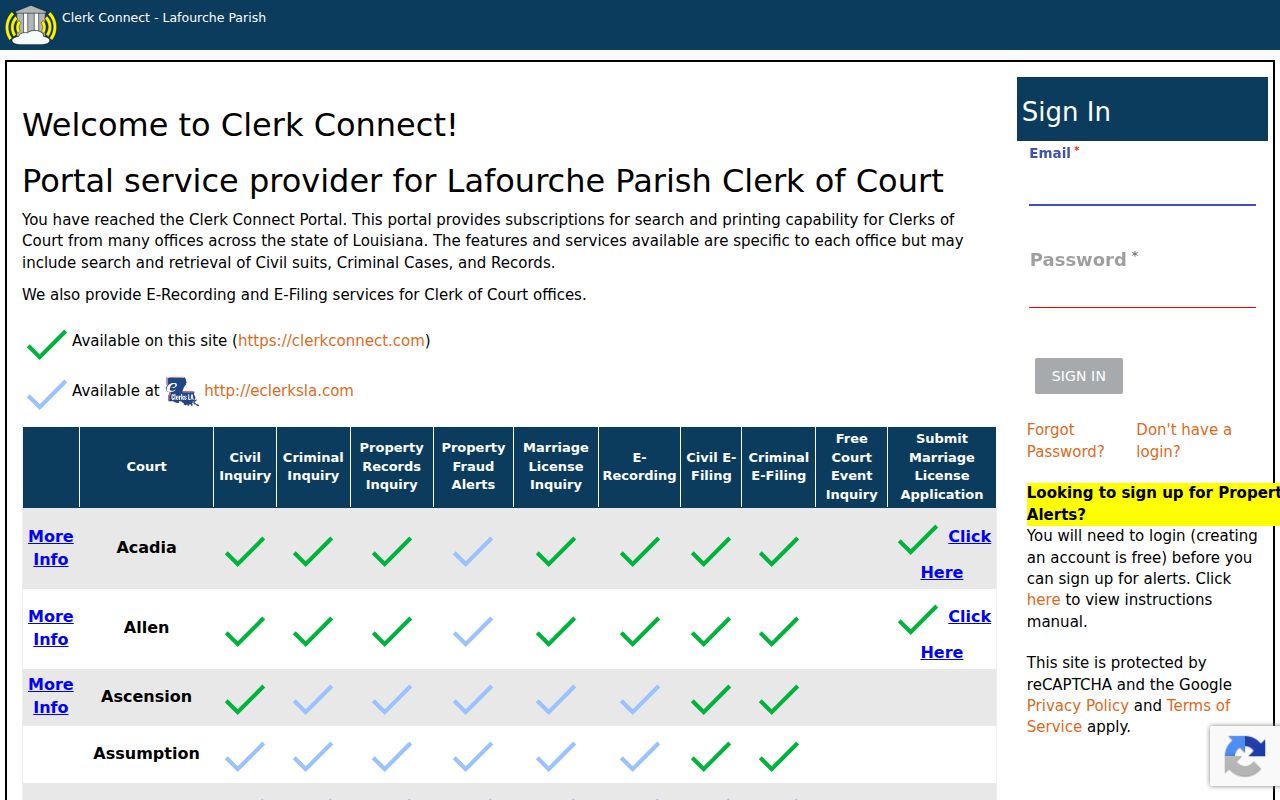
The portal image confirms the intended online route, but its live controls should still be read as displayed because the interface can change.
The live form and private case data were not inspected, so exact search controls should be verified in the portal. Public account controls include password, subscription, account, and transaction-history functions. An assigned official number does not guarantee that a matter is fully indexed. If the number appears but details do not, save it and contact the Clerk rather than treating the partial return as the complete file.
What the Case File Shows
A released file can connect the charging document to arraignment, motions, minutes, disposition, sentence, and later activity. Availability differs by date and access status, and the courthouse record controls over an online convenience copy.
| Case Number | The official docket identifier used for requests, copies, and certification. |
|---|---|
| Charges | Offenses filed by bill of information or indictment; these may differ from arrest charges. |
| Events & Dates | Arraignment, motion, hearing, trial, plea, sentencing, and later settings reflected in minutes. |
| Parties | State, defendant, counsel, judge, and division where publicly released. |
| Disposition | Guilty plea or verdict, acquittal, dismissal, nolle prosequi, or other recorded outcome. |
| Sentence | Custody, supervision, fines, conditions, or set-aside action shown in the court order. |
A certified copy costs $1 per page plus $5 certification for each docket. Give the Clerk the docket number and identify the exact instrument or minute needed; ordering an entire file may add pages that do not answer the question.
Read Minutes Before Ordering Images
Minutes often provide the fastest chronology: they show that an appearance occurred, what the court ordered, and the next procedural step. Read the minute sequence before buying an image so the request can target a bill, plea, judgment, or sentence. Images begin much later than the index, so a valid older entry may have no downloadable document.
Coverage cutoffs matter: an online absence before July 1982 is not proof that no file exists. From 1982 through 2000 the portal may provide an index without minutes, and before March 2018 it may provide minutes without document images. Ask the criminal desk about the office-held record.
Stages of a Criminal Case
A Lafourche prosecution moves through distinct records, and the charge can change along the way. The booking describes the officer’s action; the DA decides whether to file a bill of information or seek a grand-jury indictment; the Clerk records what reaches court.
- Arrest and initial appearance: law enforcement creates arrest and custody records, and a judge addresses custody and bond.
- Charging: the DA files a bill of information or uses a grand jury where required.
- Arraignment and pretrial: the plea, motions, discovery disputes, and settings create minutes and filings.
- Disposition: a plea, trial, dismissal, nolle prosequi, acquittal, or no true bill determines the charge’s course.
- Sentencing and later action: conviction leads to sentence; appeals, revocation matters, set-asides, or expungement can create further entries.
Arrest Charge, Bill, and Indictment
An arrest charge states why an officer took someone into custody. It is not the prosecutor’s final decision. A bill of information is a formal charging instrument filed by the district attorney. An indictment is returned by a grand jury where that process is used or required. A no true bill means the grand jury declined to indict; it is not another name for a conviction.
Likewise, “dismissed” and “nolle prosequi” end the specified charge without establishing guilt, while “not guilty” or “acquitted” records an adjudication against guilt. An article 893 or 894 set-aside or dismissal does not automatically erase public internet and agency records. Eligible people ordinarily must complete the separate Louisiana expungement process.
Lafourche Drug Treatment Court
Lafourche Parish Drug Treatment Court is a named alternative for screened qualifying nonviolent, non-distribution drug matters. The District Attorney reviews pending and historical information and recommends eligibility, after which participants undertake intensive treatment. The program contact is 985-446-1970.
Its involvement changes how the case timeline should be read. A docket can reflect program-related settings or later disposition activity rather than a conventional immediate sentence. Review the minutes and final order instead of inferring an outcome merely from the program name.
Access & Restrictions
Louisiana Public Records Law supplies a general inspection and copy framework, but it does not make every court record unrestricted. Juvenile material, sealed or expunged records, protected victim information, identifying data, and material covered by another legal restriction can be withheld or redacted. The Clerk releases the lawful public portion and cannot give legal advice.
Under Code of Criminal Procedure article 973, expungement makes a record confidential rather than physically destroying every trace. Listed justice and authorized entities may retain statutory access, as may the subject or counsel, and a court may permit access for good cause. Someone reviewing an own record can compare the Clerk docket with a later Louisiana State Police Bureau of Criminal Identification and Information Right to Review and send a certified order to a reporting agency when correction is needed.
For an official search, the criminal desk charges $20. A public-record email to clerk@lafourcheclerk.com can identify a record or fallback route, but it is not a request for legal advice. Describe an existing record, give a date range and docket number, and state whether inspection, a plain copy, or certification is wanted.